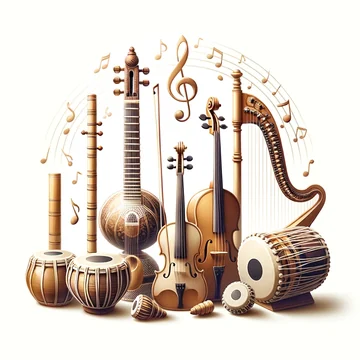
Five centuries of music, handed to every child
Carnatic music has passed from guru to shishya, voice to voice, for generations. GuruShishya keeps that thread and opens it to anyone who wants to learn, anywhere, with a guru or on their own.
Try the first lesson now, no account neededHear a raga
Tap any raga to hear it on the harp; the ones nearest the centre then play with an orchestra
A raga is a world, not a scale
Raga comes from rañj, to colour: a raga is what colours the mind. Its swaras are only where it begins. It has its own way of rising in the arohana and coming home in the avarohana, gamakas that make a swara sway or glide into the next, phrases no other raga sings, and a feeling all its own. A child comes to know a raga the way one knows a voice: by hearing it, singing it back, and being heard.
Each raga carries a feeling. Hear four of them.
Joy
ānanda · Mohanam
Mohanam sings on five swaras, with no Ma and no Ni.
Compassion
karuṇa · Revati
Revati evokes karuṇa, compassion, and many Vedic verses are chanted in it.
Valour
vīra · Arabhi
Arabhi is an auspicious raga of valour, sung early in a concert.
Devotion
bhakti · Mayamalavagowla
Mayamalavagowla is held auspicious and soothing, sung at dawn, and the first lessons are sung in it.
Hear it first
Every lesson can be heard on the harp, at the child's own sruti and a pace they can follow, before they sing a note.
Practise with the tutor
With the tanpura holding the pitch, the tutor listens to every swara, says which one slipped and which line to take again, and goes slower when they need it.
See the progress
A lamp lights for each day they practise, and the lessons cleared and the minutes practised add up through the week.
Be heard
Milestones are kept as they are reached; with a guru, the takes they send are heard and written back to.
Try it, no account needed
Sing the first lesson, and hear where you went off
Sarali varisai 1, the lesson every Carnatic student begins with. Choose a raga and your Sa, listen to it on the harp, then sing it back with the tanpura on: the tutor names the swara that slipped and the line to take again.
At home, this is the room you practise in: with a guru, it runs the drills your guru set and tells them how you did; on your own, it runs any lesson you choose from the Library.
The practice room · Sarali varisai 1
Sung in , with Sa at , the tanpura .
What is in the book
Everything a young musician needs between lessons
My Practice
A diary that opens on today
Each day's page holds the week your guru set, the pieces you added yourself, the minutes the lamp heard, and the lesson next on your path. A lamp lights for every day you practise.
- Today's pieces from your guru, and the ones you added
- A lamp for every day you practise
- Minutes counted as the tutor hears them
This week
MonSarali 3 at 60
TueGa–Ma turns
WedKunda Gowra
Thutoday
Fri
Sat
Sun
4Thursday · November
From your guru · this week
✓ Sarali Varisai 360 a minute
Ga–Ma turns45 a minute
Kunda Gowrafrom the Library
1 of 3 done · 9 of 15 minutes today
Drawn from the app; the students and their weeks are illustrative.
The Library
A book that comes alive
The exercises, geethams, nottuswarams, swarajatis, varnams and kritis are books, and each book does the whole thing: it shows the piece written swara by swara with its words, plays it to you, practises it with you, and takes your corrections.
- Read every piece, swara by swara, with its words
- Hear it on the harp, at your sruti and your pace
- Practise it with the tutor, right on the page
- Correct a swara, and the book keeps it
स्वरजतिमाला · Swarajatimālā
Swarajati
Raravenu
in the raga Bilahari
❦
- Raga
- Bilahari, janya of Shankarabharanam
- Arohana
- SR2G3PD2Ṡ
- Avarohana
- ṠN3D2PM1G3R2S
- Tala
- Adi
Heard in Bilahari, on the harp, at śruti C4, 120 a minute.
Pallavi
Heard on the harp, at your śruti and your pace; each swara lights as it sounds.
Drawn from the app; the students and their weeks are illustrative.
The practice room
Play along on the notation road
The notation runs as a road with the tanpura and the tala. The voice tutor listens to every swara; when one slips it stops, says which, and goes again more slowly. It works for the voice and for an instrument like the violin.
- The notation road with the tanpura and the tala
- A voice tutor that stops on the swara that slipped
- Slower, faster, or waiting for you
The practice room · Sarali varisai 3 · 45 a minute
Adi · 2 of 3 cleanTutorThat Ma came in a little low. Once more from Ga.
Tanpura · Sa at D#
Drawn from the app; the students and their weeks are illustrative.
The raga book
A page for every raga
Every raga under its melakarta: its arohana and avarohana to hear, what is written about it, the songs sung in it, and doors to sing its arohana and avarohana back or take five questions on it.
- Every raga under its melakarta
- Its arohana and avarohana to hear, its songs sung and played
- Ragas linked by their notes
Mohanam
janya of Harikambhoji · audava · 5
Arohana
SR2G3PD2S'
Avarohana
S'D2PG3R2S
Songs in Mohanam · hear them sung and played
By their notes
Same swaras as Bhoopali; a softer Ga, Shivaranjani.
Drawn from the app; the students and their weeks are illustrative.
The raga book
941ragas
Each has its arohana and avarohana to hear, its melakarta and the songs sung in it. The exercises are written once and sung in any of them: each swara of the line moves to the swara at its place in the raga you choose.
And the rest of the book
Everything else in it
- On your ownNo guru yet? The whole Library is yours
- A piece in the LibraryRead it, hear it, at any speed
- The tala bookThe talas, beat by beat
- Games and quizzesA quiz the moment you ask
- BadgesMedallions for the milestones
- For gurus · SādhanāEvery group's week, at a glance
- For gurus · PlanPlan the week from any book
- For gurus · WatchSee who practised, and where they stopped
- For gurus · ActThe nudge, already drafted
- For gurus · EvaluateHear every take
- For gurus · PublishYour recordings beside the Library
- The studio · NotationSing it, and see it written
- The studio · ComposeCompose on the notation
Where GuruShishya fits
The practice at home, between the lessons
GuruShishya is never a replacement for a guru. A guru may have an hour a week with each class, and many students in it; between those hours it is hard to know how each one is practising, and where they need help. That practice at home is the gap GuruShishya fills: the guru decides the drills, and the tutor sits with each student through them, every day, and tells the guru how it went.
With a guru
Join your guru's school with its code. Your guru decides each week's drills; the tutor practises them with you at home, swara by swara, and your guru sees how each day went, hears your takes and writes back.
On your own
No guru yet? A music lover can learn a great deal here: explore the world of ragas, listen deeply, which is a key part of learning, and practise any lesson in the Library with the tutor. A solid foundation in Carnatic music will always need a guru; when you find one, GuruShishya becomes your practice between their classes.
Either way, the whole Library is yours, and it keeps growing: the exercises, geethams, swarajatis, varnams and kritis, the world of ragas and talas, and the composers behind them, so a student comes to know Carnatic music in its depth and its nuance.
What people ask
What is GuruShishya?
A place to practise Carnatic music at home, between the lessons with a guru. It is never a replacement for a guru: the guru decides the drills, and the tutor practises them with each student, with the notation, a tanpura and the tala, listening to every swara and saying which one slipped. Every student has the whole Library, and it keeps growing.
Can I learn without a guru?
A music lover on their own can learn a great deal here: the world of ragas, their composers and their songs, and above all listening, which is a key part of learning. They can pick any lesson in the Library and practise it with the tutor. But learning Carnatic music with a solid foundation will always need a guru, and when you find one, GuruShishya becomes your practice between their classes.
How does a guru use it?
A guru has an hour a week with a class and cannot sit with every student between classes. In GuruShishya the guru decides each group's drills, from the Library or their own recordings; the tutor practises them with each student at home; and the guru sees who practised, where each one stopped and needs help, hears the takes they send and writes back.
Does it work for an instrument as well as the voice?
Yes. The practice room listens to the pitch you sing or play, so it works for the voice and for an instrument like the violin.
What does it cost?
It is free to start. The plans, and what each one includes, are on the pricing page.